Tennis is one of the few sports where a six-year-old and a forty-five-year-old can play together on the same court and both have a genuinely good time. That makes it unusual, and for families looking for a shared physical activity that everyone can grow into at their own pace, it is worth taking seriously.
Quick answer: Family tennis in Glendale works best when each family member is enrolled in an age-appropriate program that matches their current level, and the family plays together informally on weekends or during family court time. Most academies structure junior programs by age and adult programs by skill level, making it straightforward to get a whole household started.
This guide covers the program options available for each age group, what playing together actually looks like, and how to coordinate multiple family members starting at the same time.
Why Tennis Works for Families
Most team sports split families up by age group and put them on separate fields at the same time. Tennis does the opposite. A parent and child can share a court from the beginning, and the skill gap that often separates generations in other sports is easier to bridge in tennis because the game can be played cooperatively, at reduced pace, and with different ball types to level the playing field.
The sport also scales as children grow. A child who starts at age four in a Red Ball program can be playing competitive junior tennis at twelve and carrying that game into adulthood. A parent who starts at thirty-five as a complete beginner can reach a recreational level that makes weekend family matches genuinely competitive within a year or two of regular practice.
That long arc of development, shared across a household, is something few recreational activities offer.
How Family Tennis Programs Are Structured
Structured tennis academies organize instruction by age and skill level rather than by family unit. This is the right approach: a five-year-old and a twelve-year-old need fundamentally different coaching, different equipment, and different court dimensions to develop properly.
What this means in practice is that family members each join the program tier that matches their age and current ability, and the coordination happens off the court, through shared schedules and court time that families book together outside of formal lessons.
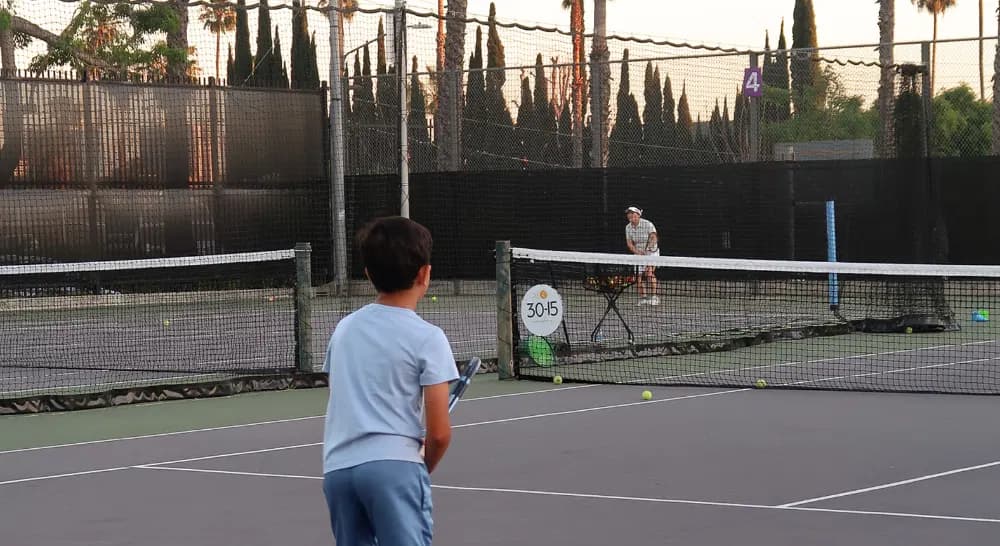
A typical family at 30-15 Tennis Academy might have a seven-year-old in an Orange Ball group class on Saturday mornings, a teenager in a Yellow Ball session on weekday evenings, and one or both parents in an adult group class two or three times per week. The programs run independently, but everyone is developing at their own pace toward the same end goal: being able to play together.
Programs for Younger Kids: Red Ball and Orange Ball
The youngest players, ages three to five, start in the Red Ball program. Red Ball uses the smallest court dimensions, the slowest ball type, and age-appropriate coordination activities that build athletic movement foundations before technical tennis mechanics are introduced. The emphasis at this stage is making the sport fun, building gross motor skills, and creating a positive early association with the game.
Ages six to eight move into the Orange Ball program. Courts are slightly larger, the ball moves a bit faster, and the focus shifts toward foundational stroke mechanics: grip, contact point, basic footwork, and rally consistency. Most kids at this stage play their first short points and start to understand the basic rules and scoring structure of the game.
For parents who want to read more about what the early junior program progression looks like, our kids tennis programs guide covers the age-based level structure in detail.
Programs for Older Kids and Teens: Green Ball and Yellow Ball
Ages nine to twelve enter the Green Ball program. Players use a full-size court and a lower-compression ball closer to a standard tennis ball. The coaching focus moves to consistent rally mechanics, shot placement, and basic tactical awareness. Players at this level are developing the physical and technical foundation for later stages of the game.
Ages thirteen to seventeen play with standard equipment on full courts in the Yellow Ball program. At this stage, coaching covers point construction, competitive patterns, serve development, and match-play scenarios. Coaches assess readiness and help players work toward school tennis or recreational competition.
The level progression from Red Ball through Yellow Ball is designed to be continuous. A child who starts at age four can move through each stage without changing academies or rebuilding their game from scratch, which matters for long-term development.
Programs for Parents: Adult Group and Private Options
Parents are often the last to sign up, and the most surprised by how quickly they develop when they do. Adult beginners in their thirties and forties routinely reach a solid recreational level within six to twelve months of consistent training.
The adult group tennis program is the standard entry point for parent players. Classes are organized by skill level, so beginners are not hitting alongside players with years of experience. Sessions cover fundamentals, rally consistency, and basic point play in a social group format that fits an adult schedule.
Parents who want faster technical development, especially those who want to reach a level where they can play meaningfully with a teenager at home, sometimes start with a few private lessons to accelerate early progress before joining a group. Either path works.
What Playing Together as a Family Actually Looks Like
The goal for most families is court time together, not just parallel enrollment in separate programs. Here is what that realistically looks like at different stages.
Early on: A parent and a young child in the Red Ball stage can share a court for fun rally sessions using mini-court dimensions. The child hits slow balls back over a low net; the parent feeds gently and keeps the ball in the child's strike zone. These sessions are less about technique and more about time on court together. They matter for building the child's relationship with the sport.
As the child develops: A child in the Orange and Green Ball stages can start participating in genuine cooperative rallying with a parent who has been training as well. Both players are now working on similar fundamentals, even if at different paces. Hitting together at this stage becomes useful practice for both.
When the child reaches Yellow Ball: A teen at the Yellow Ball level who has been training consistently will likely be able to beat a parent who started as an adult beginner. This is something to celebrate, not to avoid. Competing against your child in a real match is one of the genuinely unique rewards of the sport, and it only happens if everyone started.
Weekend family court time: Many families book open court time on weekends to play doubles with two adults against two kids, or round-robin formats where everyone rotates. This kind of informal family court time reinforces the social side of tennis and gives everyone extra reps outside of structured lessons.
Getting Multiple Family Members Started at the Same Time
If several family members are starting together, the simplest approach is to contact the academy directly and explain the ages and starting levels of everyone in the household. Staff can coordinate program placements, help align schedules to minimize separate trips, and explain whether any shared enrollment options apply.
Starting everyone at the same time, rather than phasing it in, tends to sustain the family motivation dynamic better. When everyone is in it from the beginning, the shared language, the shared complaints about forehands, and the shared wins on court create a household culture around the sport that is much harder to build if one person is a year ahead of everyone else.
A free first group trial is available for eligible junior players and adult beginners/intermediates. It is a low-commitment way to experience the program before enrolling. Adult Advanced/Live Ball and private lessons do not include free trials.
Frequently Asked Questions
At what age can a child start tennis lessons in Glendale?
The Red Ball program accepts children from age three. At this stage, sessions focus on movement, coordination, and introduction to the racket and ball in a playful, age-appropriate format. Most children starting at three to four are ready for structured group activity and benefit from the early motor development the program provides.
Can parents and kids take lessons together?
Structured programs separate juniors and adults because the coaching, equipment, and court dimensions are different at each stage. Families can also arrange suitable public court time to play informally outside lessons. Training in their respective programs helps family members develop the skills to make shared court time enjoyable.
What if my child wants to play competitive tennis eventually?
The junior program progression from Red Ball through Yellow Ball builds the foundation for competitive development. Players who train consistently through the Green Ball and Yellow Ball stages with a structured academy develop the technical and tactical base for school team play and recreational tournament competition. Talk to the coaching staff at enrollment about your child's competitive goals.
Is tennis a good sport for kids who are not particularly athletic?
Yes. Tennis develops coordination, footwork, and hand-eye skills rather than requiring pre-existing athletic ability. Many of the sport's best adult recreational players started as children who were not standout athletes in other sports. The early age progression in a good junior program is designed to build those skills from the ground up.
How do I coordinate scheduling for multiple family members at different levels?
Contact the academy with the ages and levels of everyone in the household. Staff can help align program placements and class schedules to reduce the number of separate trips per week where possible.