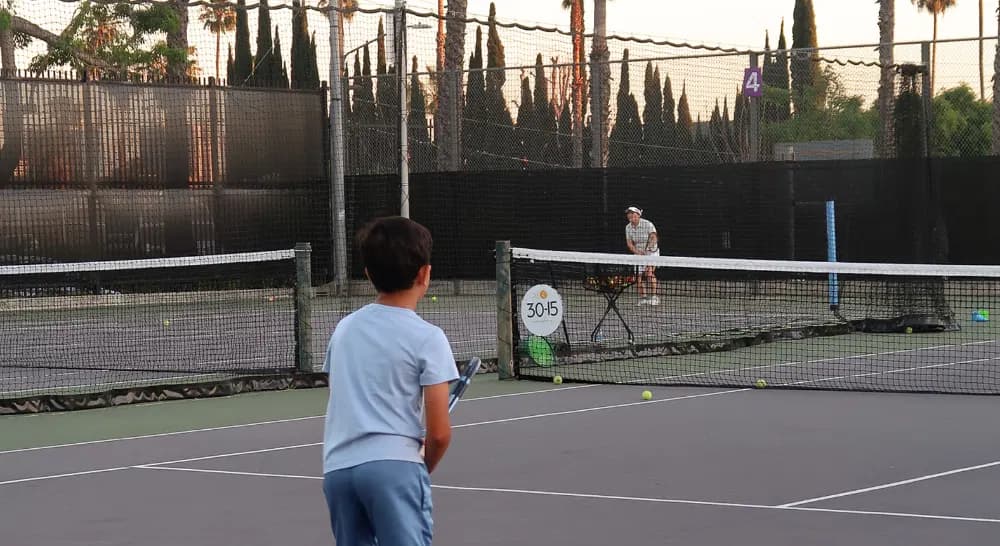
Quick answer: Junior tennis is a staged pathway. At 30-15 Tennis Academy, children typically start on Red Ball (around ages 3 to 5), move to Orange (around 6 to 8), then Green (around 9 to 12), and finally Yellow, the standard ball and full-size court for ages 13 to 17. Ages are a rough guide. A coach moves a child up based on skill, not birthdays.
If you are choosing a first program for your child, the colors can look like jargon. Parents often ask why a child cannot simply start with a regular tennis ball. The short answer is that each stage matches the equipment and court to the child’s size and coordination. At 30-15 Tennis Academy in Glendale, the junior tennis program follows this structure, starting with Red Ball for the youngest players.
This guide walks through the pathway from Red to Yellow, explains what changes at each step, and shows how coaches judge readiness. If you are still comparing programs by age and enrollment details, our overview of kids tennis programs in Glendale covers that side. For the official background on the format, see the USTA guide to finding the right tennis level and the ITF Tennis Play and Stay page.
Why Junior Tennis Uses Colored Balls
Tennis is physically demanding for small bodies. A standard ball bounces high and travels fast, and a full-size racquet is long and heavy. A young child facing that equipment tends to swing awkwardly, miss often, and lose interest.
The USTA’s 10 and Under Tennis format, which follows the ITF’s Play and Stay approach, solves this by shrinking the game: slower, lower-bouncing balls, shorter racquets, and smaller courts. The idea is to let children rally and play points early, then grow the game as the child grows.
A color therefore tells you three things at once: the ball, the court, and the racquet size a child is using. It also hints at the skills being built, which is why stages are named by color and not strictly by age.
The Four Stages at a Glance
| Stage | Usual academy age | What it is for | Main goal |
|---|---|---|---|
| Red | Around 3 to 5 | First contact with the sport | Coordination, contact, fun |
| Orange | Around 6 to 8 | First real rallies | Consistent forehand and backhand, early serve |
| Green | Around 9 to 12 | Full-size court, slower ball | Technique, tactics, point play |
| Yellow | Around 13 to 17 | Standard ball, full court | Consistency under pressure, match play |
Court sizes follow the USTA format: Red uses a 36-foot court, Orange uses a 60-foot court, and both Green and Yellow use a full 78-foot court. The USTA guide linked above gives the singles and doubles widths for each stage.
Red Ball: The Starting Point (Around Ages 3 to 5)
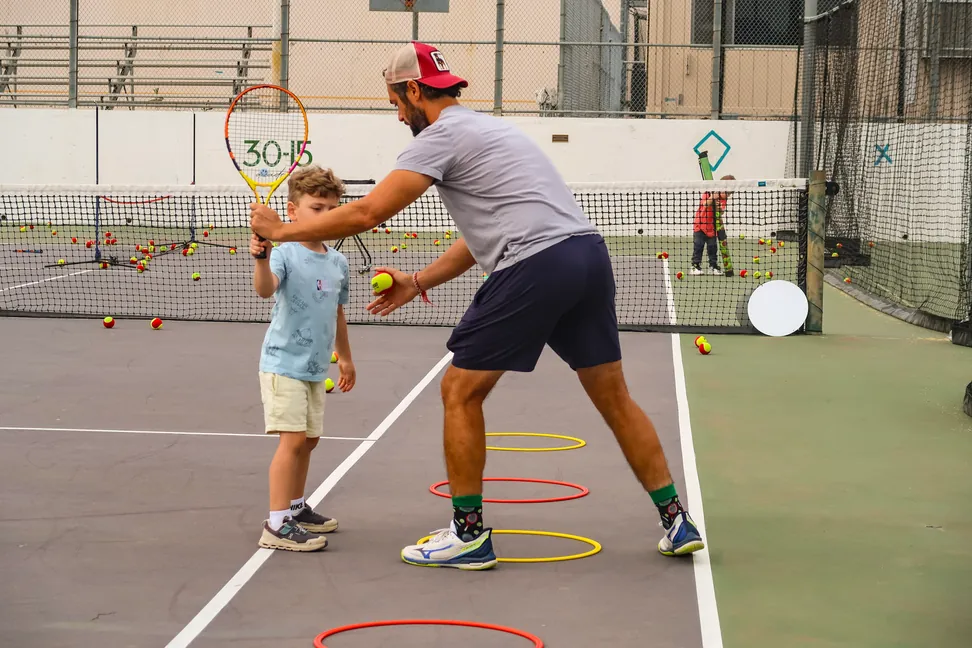
Red Ball is where most children begin. The ball is large, soft, and slow, and the court is small. The first goal is not technique. It is making contact, moving toward the ball, and enjoying time on a tennis court.
Typical goals include tracking a bouncing ball and moving to it, holding the racquet and making simple contact, and building throwing, catching, and bouncing skills that feed hand-eye coordination. Sessions are short and game-based, with targets, hoops, and relay-style activities in place of long drills.
For ages, court size, and the skills list in full, read our dedicated guide to Red Ball tennis ages, court size, and skills.
Orange Ball: Learning to Rally (Around Ages 6 to 8)
Orange Ball is the first big step toward standard tennis. The court is bigger than Red, and the ball is faster and bounces higher while remaining easier to control than a standard ball. Children begin to string together rallies instead of single hits.
Skills that develop here usually include a more consistent forehand and backhand, a basic serve to start a point, early footwork such as the split step and recovery, and simple scoring. The jump from Red to Orange is where many children first feel real progress, because longer rallies are suddenly possible.
If your child is at this stage, our guide to Orange Ball lessons and milestones explains what coaches look for, and the Orange Ball program page describes the level itself.
Green Ball: Building Real Tennis Skills (Around Ages 9 to 12)
Green Ball uses a ball that is slower than a standard ball but much closer to it, on a full-size court. Players are ready for more structure: stroke technique, tactics, and playing full points with purpose.
Coaches typically work on cleaner stroke mechanics, a reliable serve and return, directional control (crosscourt and down the line), and introductory point construction such as hitting deep to create time. This is also where children often start to think about competition. See our Green Ball guide and the Green Ball program page.
Yellow Ball: The Full Game (Around Ages 13 to 17)
Yellow Ball is standard tennis: the regulation ball on a full-size court. By this point players have built the coordination, strength, and stroke foundation to handle the full-speed game. Training shifts toward consistency under pressure, tactics, patterns of play, and match experience. The Yellow Ball program is designed for this stage, and players who want to compete can read our guide to advanced training and competitive drills.
How Coaches Decide When a Child Moves Up
Age ranges are guidelines, not deadlines. A child who is young for their group may need extra time, while another may be ready early. Coaches commonly watch for five signals:
- Rally consistency. Can the child keep the ball in play for several exchanges at the current stage?
- Stroke control. Can they hit forehands and backhands to a target with reasonable accuracy?
- Court movement. Do they move their feet to the ball instead of reaching and swinging?
- Game understanding. Can they follow scoring, rules, and simple tactics?
- Enjoyment. Is the child still having fun? Moving up too soon can hurt confidence.
The most reliable way to place a child is a short assessment with a coach. You can arrange that through a free group trial.
A Simple Way to Self-Check at Home
If you want a rough read before a trial, try this with a soft ball in a park or yard. These are informal checks, not a placement test.
- Red readiness: Can your child roll, toss, or bounce a ball to you and track it as it comes back?
- Orange readiness: Can they hit a gently fed ball over a low barrier more often than not?
- Green readiness: Can they exchange several hits in a row and keep score without prompting?
A child who struggles with a check is not behind. It simply shows where practice will help most.
Common Mistakes Parents Make
- Rushing to the next color. Moving up before a child can rally comfortably usually leads to frustration, not faster progress.
- Comparing children by age alone. Two eight-year-olds can sit in different stages, and that is normal.
- Skipping fundamentals. Time spent on footwork and coordination early on pays off in later stages.
- Treating tennis only as a training path. For young children, play and enjoyment matter more than results.
If your family has more than one player, our guide to family tennis in Glendale covers playing together across ages and levels.
Frequently Asked Questions
What is the order of tennis ball colors for kids?
The usual order is Red, Orange, Green, then Yellow. Red is the smallest and slowest format, Orange and Green step up in court size and ball speed, and Yellow is the standard ball on a full-size court.
Why do kids use different colored balls in tennis?
Different balls and courts match the game to a child’s size and coordination. Slower, lower-bouncing balls give young players time to swing and rally, which makes learning easier and more enjoyable.
Can my child skip a stage?
In some cases, yes. A child who joins at an older age but already shows good coordination may start at Orange or Green. Coaches place players by skill during an assessment, not by automatically starting everyone at Red.
How long does a child stay at each stage?
It varies a lot. Some children progress within months, while others spend a year or more at one stage. Progress depends on coordination, confidence, and how often they play, so there is no fixed timeline.
How do I find out which level fits my child?
Book a free group trial so a coach can watch your child play and recommend a stage. You can also compare levels on the junior tennis page.